
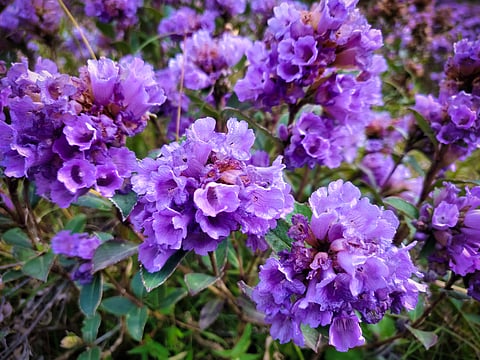
There are some moments in life that quietly take your breath away — today was one of them. I’m at Munnar right now, staying at the beautiful Neelakurinji Plantation Resort, and for the first time in my life, I actually saw the Neelakurinji plant and its flowers in person.
For years, Neelakurinji has been a textbook fact for me — “blooms once in 12 years,” the teachers said. It was one of those things I memorised for exams without ever imagining that I’d one day stand in front of the real thing. Later, social media made it look almost mythical with those blue carpets rolling across hill slopes. But nothing prepared me for the quiet thrill of seeing it with my own eyes.
A Flower That Teaches Patience
Neelakurinji (Strobilanthes kunthiana) is one of nature’s most disciplined timekeepers. It doesn’t care about human schedules, long weekends, or tourist seasons.
It blooms only once every 12 years, as if it wants to remind us that beauty is worth waiting for. The last bloom was in 2018, which means the next grand spectacle will only happen in 2030.
Standing here today, looking at a plant that has its own slow, deliberate rhythm, I was instantly humbled. How many things in life take 12 years to prepare for a moment of glory?
Why It’s Called “Neelakurinji”
The name is beautifully literal — ‘Neela’ meaning blue, and ‘kurinji’ referring to the hill region where it grows.
When thousands bloom together, the hillsides turn into a surreal bluish-purple carpet. That dramatic makeover is why Munnar becomes a pilgrimage spot for nature lovers during the blooming year.
A Plant That Exists Nowhere Else on Earth
One thing that surprised me was just how rare this little flower is.
Neelakurinji is endemic to the Western Ghats — meaning it grows only here and nowhere else in the world. These hills are its home, its birthplace, and its entire universe.
Seeing it today made me feel strangely protective, as if I was meeting a vulnerable species that thrives only in pockets of untouched wilderness.
A Bloom That Even Shapes Human Life
The Kurinji bloom isn’t just a botanical event — it has even influenced culture.
The Paliyan tribal community used the blooming cycle to calculate age. Instead of saying “I’m 24 years old,” they would say, “I’ve seen two kurinji blooms.” What a poetic way to measure life — imagine marking time in flowers instead of numbers.
Not Just a Pretty Flower
Here’s what I didn’t know until today:
Neelakurinji flowers are incredibly important for hill ecology.
They provide food for bees and help sustain honey production in the region.
After blooming, the plant dies, but new ones regenerate from seeds — continuing the 12-year cycle.
It’s almost like a festival of regeneration.
Nothing Like Seeing It in Person
I realised something today — reading about Neelakurinji is one thing, but seeing the plant up close in Munnar’s cool air, with the mountains rising around me, is entirely different.
Even though it’s not a mass-bloom year right now, just seeing the plant, touching the leaves, and knowing what it’s capable of every 12 years made the experience incredibly meaningful. It felt like meeting a celebrity — but a gentle, quiet one who doesn’t care for the spotlight except once every decade or so.
As I stood there, I felt grateful. Grateful that nature still has secrets. Grateful that patience is still rewarded. And grateful that I got to witness, even in its resting phase, a flower that has fascinated humans for centuries.
I’m already making a mental note: 2030 — return to Munnar.
Some dates are worth blocking years in advance.
